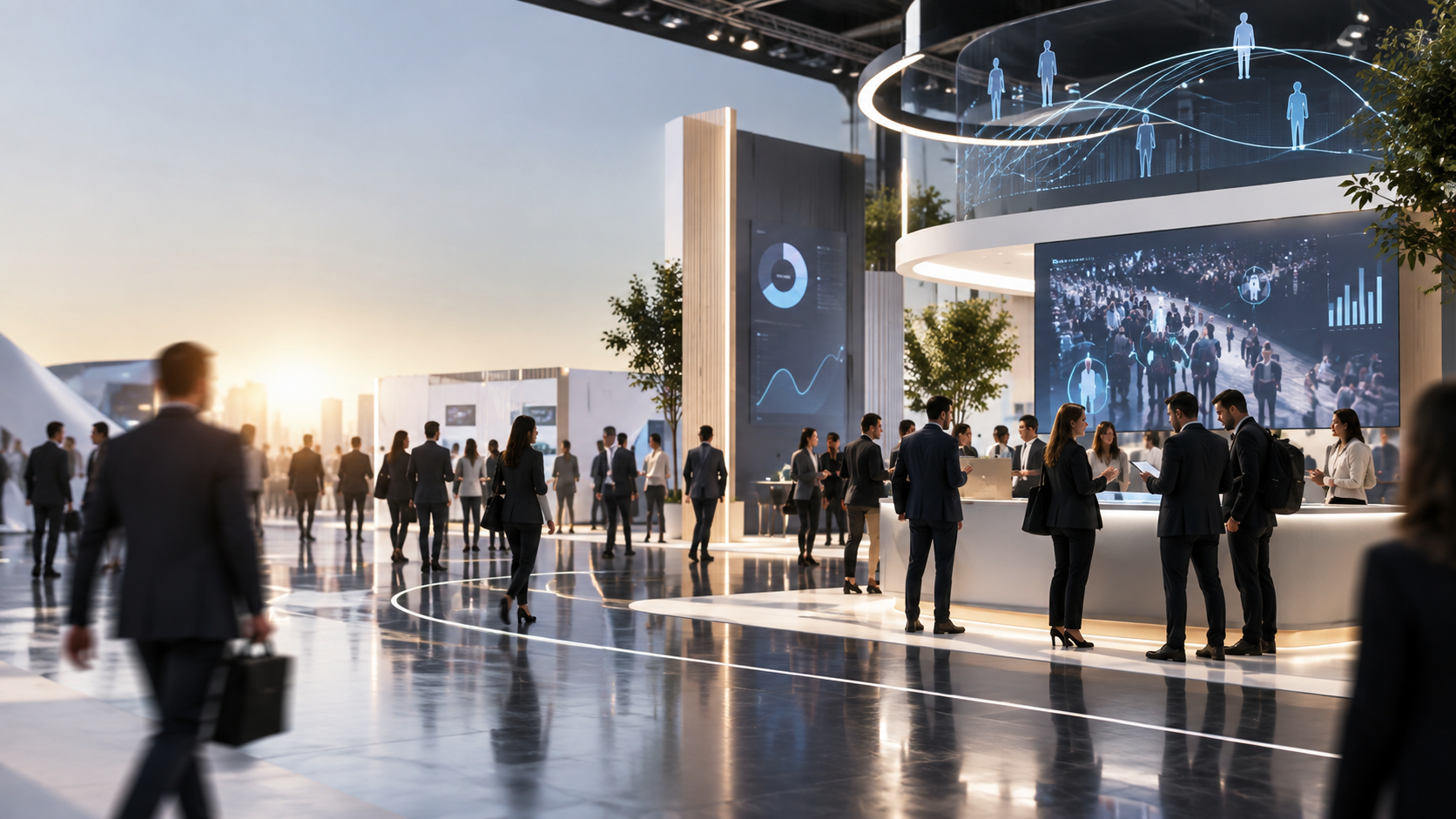
Trade shows, exhibitions and corporate events remain some of the most powerful environments for creating real-world customer experiences.
Companies invest heavily in booth design, staffing, sponsorships, hospitality and brand activation.
Yet one question is still surprisingly difficult to answer:
What actually happened at the booth — and was the investment worth it?
For many exhibitors, event performance is still assessed using a combination of lead counts, badge scans, anecdotal feedback and the general impression that a booth was “busy”.
But busy does not necessarily mean successful.
Until recently, there were understandable reasons why companies did not systematically measure what happened in physical event spaces.
Analytics solutions could be expensive.
Implementations could be complex.
Additional hardware could be required.
And the quality of the resulting data did not always justify the investment.
That equation is changing.
The technology has matured
The concept of analysing visitor behaviour in physical spaces is not new.
For years, technologies have promised to measure footfall, movement and engagement.
The difference today is that computer vision and AI have reached a significantly higher level of maturity.
Modern systems can analyse visitor flows, occupancy, dwell times and spatial behaviour with greater reliability than earlier generations of technology.
At the same time, deployment has become considerably easier.
Instead of requiring complex proprietary infrastructure, modern analytics solutions can increasingly work with standard camera technology or existing video infrastructure.
This lowers both the technical and operational barriers to adoption.
The economics have changed as well
Technical maturity alone is not enough to create a compelling business case.
The second major development is cost.
Flexible licensing models and usage-based approaches increasingly allow companies to deploy analytics without committing to large upfront investments.
For temporary environments such as trade shows and corporate events, this matters.
An exhibitor may only need analytics for several days.
Historically, implementing sophisticated measurement technology for such a short period could be difficult to justify economically.
Today, the cost structure is changing.
Analytics can increasingly be deployed specifically where and when it creates value.
This turns measurement from a major infrastructure decision into an operational tool.
Why this matters for event marketing
Trade shows represent substantial investments.
Booth construction, floor space, travel, accommodation, personnel, sponsorships and activation concepts can quickly add up.
Against that background, the cost of analytics is becoming relatively small.
And that changes the calculation.
If companies invest significant budgets in creating a physical customer experience but have very limited data on how visitors actually interact with it, an important information gap remains.
- Which areas attracted visitors?
- Where did they spend time?
- Which activation generated engagement?
- Where did visitor traffic slow down?
- Did a new booth concept perform better than the previous one?
- Was staffing aligned with actual demand?
- Which events justify continued investment?
- Without data, many of these decisions remain based on assumptions.
The cost of not knowing
This is where the business case for event analytics becomes increasingly compelling.
If measuring visitor behaviour requires an expensive infrastructure project, companies may reasonably decide that the information is not worth the cost.
But once measurement becomes affordable, easy to deploy and technically reliable, the decision changes.
The question is no longer only:
What does measurement cost?
It is also:
What does it cost us not to know?
A poorly performing booth concept may be repeated the following year.
An underused area may remain part of the design.
Staffing may continue to be based on assumptions.
Marketing budgets may be allocated to events that generate less engagement than expected.
And successful concepts may not be recognised because there is insufficient evidence to distinguish them from less effective ones.
In that context, analytics is not simply another technology investment.
It becomes a way of reducing uncertainty.
Physical marketing is catching up with digital marketing
Digital marketing teams would rarely invest heavily in a campaign without measuring performance.
Websites, advertising campaigns and digital customer journeys are continuously analysed.
Teams measure traffic, conversion rates, engagement and behaviour.
- They test.
- They compare.
- They optimise.
Physical marketing environments have traditionally operated differently.
A trade show may represent one of the largest individual marketing investments of the year — yet its performance may still be assessed primarily through lead numbers and subjective impressions.
This gap is becoming increasingly difficult to justify.
Especially when the underlying analytics technology is becoming more accessible.
Why now?
Several developments are now coming together.
Computer vision has improved.
Integration has become easier.
Existing or standard camera infrastructure can increasingly be used.
Flexible commercial models are lowering financial barriers.
And companies are under growing pressure to demonstrate the return on marketing investments.
This combination creates a new situation.
Event analytics is moving from an interesting technological possibility towards a practical business tool.
For companies that regularly invest in exhibitions and physical customer experiences, this creates an important strategic question:
If the technology is now accurate, accessible and economically viable — why continue leaving one of your largest physical marketing investments largely unmeasured?
Because increasingly, the cost of not knowing what worked may become higher than the cost of measuring it.